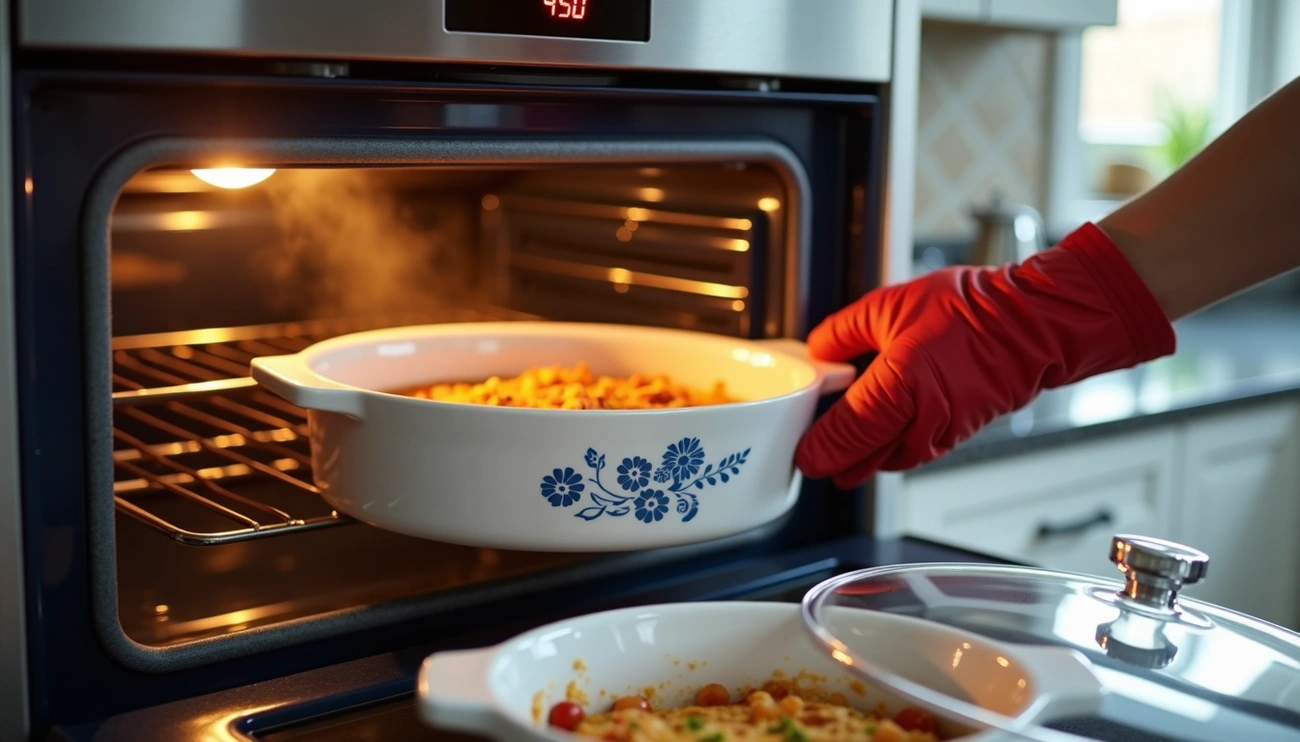
Yes, CorningWare can go in the oven up to 500°F in both conventional and convection ovens. Vintage Pyroceram CorningWare withstands extreme temperature shifts, including freezer-to-oven use. Modern stoneware CorningWare requires a preheated oven and should not face sudden temperature changes. CorningWare is also microwave and dishwasher safe.
How Oven-Safe Is CorningWare?
CorningWare has established itself as a kitchen staple primarily because of its heat-resistant properties. Whether you’re baking a casserole or reheating leftovers, understanding exactly how oven-safe your CorningWare dishes are can make a significant difference in their longevity and performance.
Understanding the oven-safe label
The “oven-safe” label on CorningWare products isn’t just marketing—it’s a promise backed by specific material properties. Modern CorningWare dishes are specifically designed for oven use and are compatible with conventional, convection, and microwave ovens. This versatility stems from their unique composition, which allows them to withstand high temperatures without warping or cracking under normal conditions.
Nevertheless, not all CorningWare products have the same heat tolerance. Always check the bottom of your dish for any unglazed areas—this typically indicates it’s stoneware rather than Pyroceram. Furthermore, newer stoneware pieces often come with warnings stating they should not be used on stovetops, though they remain oven-safe.
CorningWare oven safe to what temperature
According to official sources, most CorningWare can safely handle temperatures up to 450 degrees Fahrenheit. Yet, temperature limits vary based on the specific product line:
- Pyroceram pieces: Can withstand 450°F to 500°F
- Stoneware pieces: Generally safe from 350°F to 400°F
- Glass lids: Should not exceed 350°F
Despite these impressive heat tolerances, some caution is necessary. According to expert advice, although CorningWare is rated for temperatures up to 500 degrees, most recipes don’t require heat beyond 450°F, making this a practical limit for everyday use.
Why material type matters
The material composition of your CorningWare directly affects its heat resistance and durability. Original CorningWare (1958-1998) was made of Pyroceram, a revolutionary glass-ceramic material developed by Corning Glass Works. This exceptional material could withstand extreme temperature changes—from freezer to hot oven—without breaking.
Subsequently, after 1998, production shifted to stoneware, which has different thermal properties. Though still heat-resistant, stoneware is more susceptible to thermal shock than Pyroceram. This explains why vintage CorningWare commands premium prices at resale—its thermal shock resistance is superior to modern versions.
Thermal shock resistance remains crucial for practical cooking scenarios, especially when transferring dishes between different temperature environments. Consequently, understanding which material your CorningWare is made from helps prevent damage and ensures safety during cooking.
Types of CorningWare and Their Heat Limits
Not all CorningWare dishes are created equal. Since its introduction, this iconic cookware has evolved through different materials, each with distinct heat tolerances that directly affect how you can use them in your oven.
Pyroceram: High heat resistance
The original CorningWare was born from a happy accident in 1953 when scientist S. Donald Stookey of Corning Research and Development Division discovered Pyroceram. This revolutionary glass-ceramic material can withstand a thermal shock of up to 450 K (840°F), making it remarkably durable for kitchen use.
Pyroceram’s exceptional properties stem from its aerospace industry origins, where it was meticulously engineered to handle extreme temperatures. Originally manufactured between 1958 and 1998, these pieces represent the gold standard of CorningWare heat resistance. Essentially, Pyroceram cookware can safely transition from freezer to oven without cracking. Modern Pyroceram CorningWare returned to production in 2009, offering heat tolerance up to 500 degrees Fahrenheit.
Stoneware: Lower heat tolerance
In 1998, production of Pyroceram CorningWare in the US ceased, and the brand shifted to manufacturing stoneware products. These newer pieces maintain the classic appearance but possess notably different heat properties.
Stoneware CorningWare items are certainly oven-safe but cannot withstand direct stovetop heat or broiler use. Their maximum temperature typically ranges from 400-425°F, significantly lower than their Pyroceram counterparts. Moreover, stoneware warnings often explicitly state against broiler or stovetop use.
CorningWare glass lids: Can they go in the oven?
CorningWare glass lids are indeed oven-safe—yet with important limitations. Unlike the dishes themselves, these lids (typically made of Pyrex, not Pyroceram) have stricter temperature restrictions.
The official guidance states glass lids can safely go in conventional, convection, or microwave ovens up to 350°F. Nonetheless, you must take precautions: always preheat the oven before inserting glass lids, never place them directly under broilers, on stovetops, or over open flames, plus allow them to cool before cleaning to prevent thermal shock.
For optimal safety, remember that even the most heat-resistant CorningWare items should never experience sudden temperature changes. Allow refrigerated dishes to warm slightly before placing them in a hot oven.
Using CorningWare in Different Oven Types
CorningWare’s versatility truly shines when considering the various oven types it can be used in. Let’s explore how different cooking environments affect your favorite glass-ceramic dishes.
Conventional ovens
Conventional ovens represent the optimal environment for CorningWare. Their consistent heat distribution makes them perfect for baking and roasting with these versatile dishes. For best results, place your CorningWare on a rack positioned away from direct heat sources at the bottom or back of the oven.
Convection ovens
With forced air circulation, convection ovens may create “hot spots” that affect cooking. Fortunately, CorningWare stoneware can safely handle preheated conventional or convection ovens. Just keep your dish a few inches above the oven floor and away from the sides when using convection mode.
Broilers: What to avoid
Caution is necessary with broilers! Original Pyroceram CorningWare (produced before 2000) can withstand broiler temperatures, yet newer stoneware versions absolutely cannot. Broilers operate at extremely high temperatures (500-550°F), often exceeding the limits of modern CorningWare. Never place glass lids under broilers as they may shatter.
Toaster ovens
The relationship between CorningWare and toaster ovens is somewhat complicated. Official guidelines from the manufacturer now advise against using stoneware in toaster ovens. Nevertheless, some vintage Pyroceram pieces may work safely. Always ensure your dish doesn’t touch any interior surfaces if you do use it in a toaster oven.
Microwave ovens
Almost all CorningWare is microwave-safe. The only exception is the older “Centura” line, which lacks microwave compatibility. For optimal microwave use, check that your dish has the “microwave-safe” label, primarily if it’s an older product. Plus, remember to vent lids appropriately when heating food to prevent pressure buildup.
Best Practices for Safe Oven Use
Proper safety practices are vital for anyone using CorningWare in the oven. Even with their exceptional heat resistance, following these guidelines ensures both your safety and the longevity of your dishes.
Check the temperature limit before use
First and foremost, always check the bottom of your CorningWare dish, instruction booklet, or original packaging to confirm its maximum temperature rating. Most Pyroceram pieces can withstand up to 500°F, yet stoneware versions typically max out at 400-450°F. Going beyond these limits risks damaging your cookware permanently.
Avoid sudden temperature changes
Thermal shock remains the primary cause of CorningWare breakage. To prevent this, never transfer dishes directly from freezer to hot oven. Similarly, avoid placing hot bakeware on cold countertops, wet surfaces, or directly into cold water. Allow your hot dish to cool gradually on a cooling rack, dry potholder, or cloth.
Use oven mitts and heat-safe surfaces
Given that CorningWare retains heat exceptionally well, always handle hot dishes with dry oven mitts or potholders. The safest place for cooling hot CorningWare is on a cooling rack or dry cloth—never on metal surfaces or wet towels.
Don’t use damaged or chipped dishes
Under no circumstances should you use cracked, chipped, or severely scratched CorningWare. Even minor damage can compromise structural integrity, potentially leading to sudden breakage during cooking or handling. Plus, these cracks may harbor bacteria.
Conclusion
CorningWare certainly belongs in your oven, though its safety depends largely on which type you own. Throughout this guide, we’ve seen how Pyroceram pieces excel with impressive heat tolerance up to 500°F, while stoneware versions handle more moderate temperatures between 350°F and 400°F. Glass lids require additional caution, maxing out at 350°F regardless of dish type.
Knowing exactly which CorningWare material sits in your kitchen cabinet matters significantly. The vintage Pyroceram pieces offer remarkable versatility, transitioning seamlessly from freezer to oven without issues. Meanwhile, newer stoneware versions demand more careful handling, particularly regarding temperature changes.
Before placing any CorningWare in your oven, check its specific temperature rating. Sudden temperature shifts remain the biggest threat to your beloved dishes, so allow refrigerated items to warm slightly before baking. Similarly, hot dishes need gradual cooling rather than immediate contact with cold surfaces.